It’s an ongoing inquiry and practice. How to get folks to notice what is happening while it’s happening and then be able to harvest some small part of their intuitive learning.
Usually, if I am teaching, leading or facilitating, or being a friend I simply ask: what did you notice, discover, observe, find out?
Sometimes I modify that. What happened to your body, to your mind, to your sense of the room, to your ideas about creativity… anything to jog their capacities to recognize because if they do, they can keep it; keep it for later, keep it as a mirror, keep it as a keepsake. Sometimes when I ask, and there’s a long silence, I will say: “you just lived 5 minutes of your life, what happened?”
I want people to be able to articulate the ineffable. I know it’s hard, I know many might want to let it lie within the somatic or in a sensibility that is indescribable… but actually the attempt to find words helps uncover the event itself and give those who just experienced something a way to recall it and grow from it.
Sometimes I want to ask because I actually don’t know what just happened. I know what I want to have happened. I know what I think might have happened because I have done this before, or used it myself in making stuff. Even though I think I can “read the room” in fact I often can’t…or I am misreading the signals and symbols. It’s better to ask.
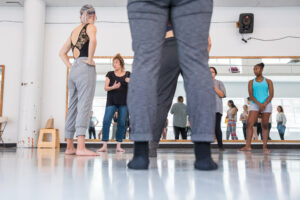
Take my current third year university students. I love this group already. They stay focused, they work hard, they engage. But I am never quite sure what’s actually going on for them.
Lately, I have saved a few minutes at the end of class to ask them. It goes like this: what was interesting for you today, and what could we have done to make it more interesting? Or what remains with you right now, and what could we have done to make it more memorable for you? What will you tell your roommate we did today and what will make the story more fun or curious to relate? They have a lot to say and they tell me a lot.
Every time they speak, they are offering their classmates an opportunity to relive the time we just spent together. And often they are giving me a chance to frame their encounter with the material with a slightly larger perspective. They get to see the implications of their experience. Sometimes they say magical things. For example, recently I heard:
“I felt like I was back in the good old days. We had our worries but we were joyful.”
Yes, we have our worries, but we can gather in joy.