Sometimes I fear our interest in being inclusive leads to a generalization. So descendants become “who comes after you.” Actually this is a fine one, but I do think we can overdo our concerns about remembering to include everyone. This is highly problematic, and actually possibly politically incorrect. But I will try.
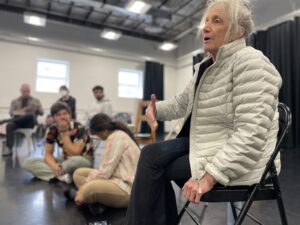
In the 90’s the Dance Exchange company was almost equally divided between older and younger dancers. I liked this arrangement very much. It led to some beautiful partnering, and some very good choreography (I am thinking of Shehechianu, This Is Who We Are, Nocturnes, Flying into the Middle, all in the same period). This was also a period devoted to themes of identity. The combination of so many elders, four generations of gay men, and the presence of several African American women, led us to examine our theories and practice around inclusivity and exclusivity.
At one point, all but two of the older dancers complained about how they were losing their hearing. We had some lively debates about what to do about this. They wanted the youngers to speak up more. Sometimes we would remember and sometimes we wouldn’t. So then the older dancers began to complain that they didn’t want to remind the youngers to talk louder. For a while we appointed a person to do the reminding, but this practice didn’t last long.
Finally, in exasperation, one of the older dancers said to me, “why don’t you just tell me when I need to listen and I’ll tune out the rest of the time.” At that moment, I noticed that she was not sitting in the circle, but actually several feet away. I got angry. I said, “You have to sit near me, or at least in the circle. You have to actively belong, despite the feeling you have that I have forgotten your problem.”
And that was when I began to think about active belonging as a kind of corollary to the very important activity of dominant groups to work on their inclusiveness. Active belonging is not a substitute of the difficult and ongoing work of remembering to think about who needs to be included. But at the same time, people who feel marginalized can take an active step towards belonging. It is difficult, and might be met with resistance. But I think it can be an active practice and actually begins to interrupt some of the patterns around victimization.