
Transform How You Give and Receive Feedback
Learn Liz Lerman’s Critical Response Process® in a brand new, self-paced online course
Feedback doesn’t have to hurt. Build trust, deepen your practice, and create the conditions for honest, generative conversations about meaningful work.
Everyone, from artists to educators to team leaders, knows this feeling…
Someone asks: “Can I give you some feedback?” and your body tenses. You brace for impact.
Or maybe you’re on the other end of the conversation—you have thoughts about someone’s work, but you don’t know how to share them without crushing their spirit or coming across as a know-it-all.
Feedback doesn’t have to be painful.
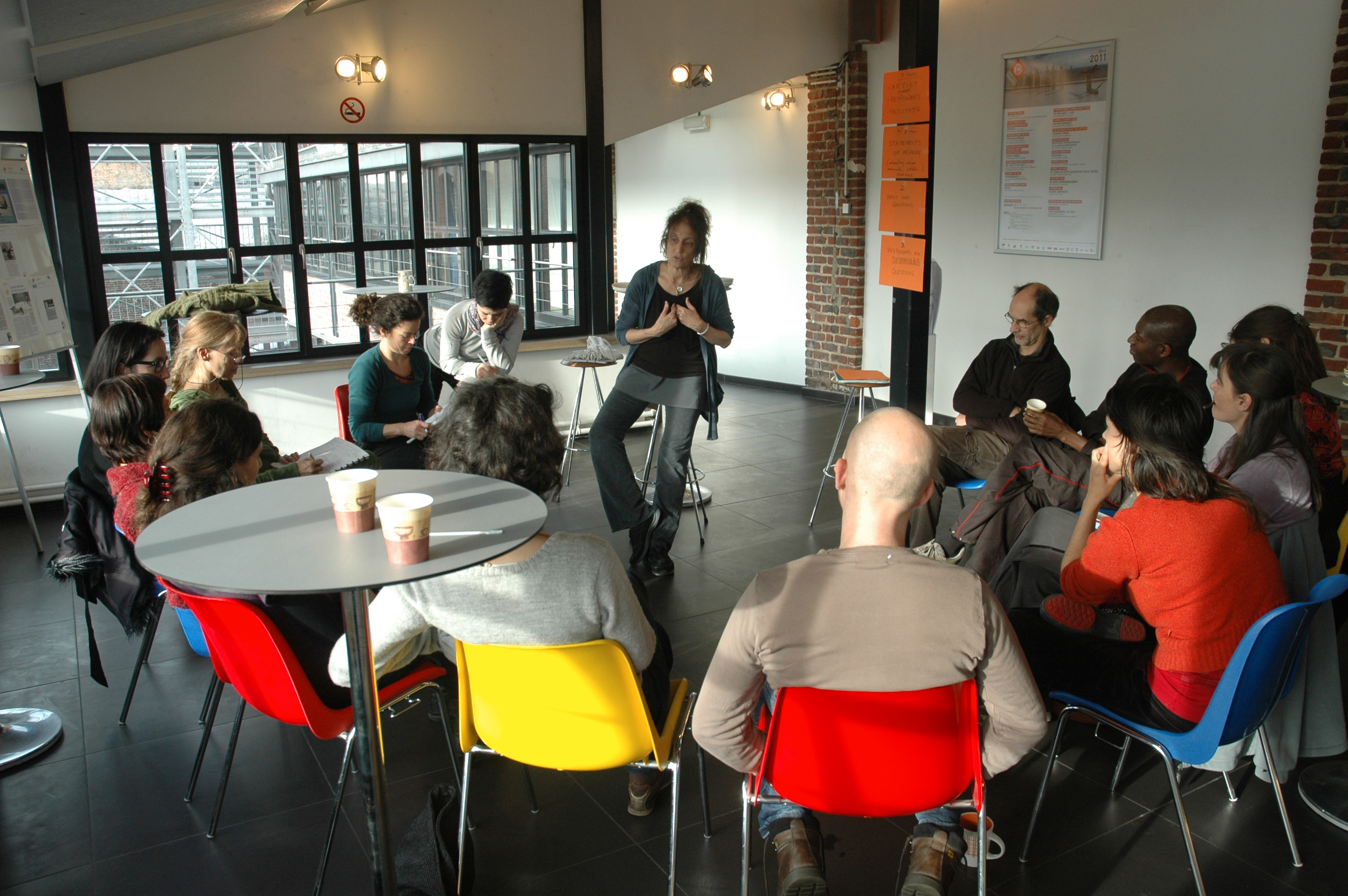
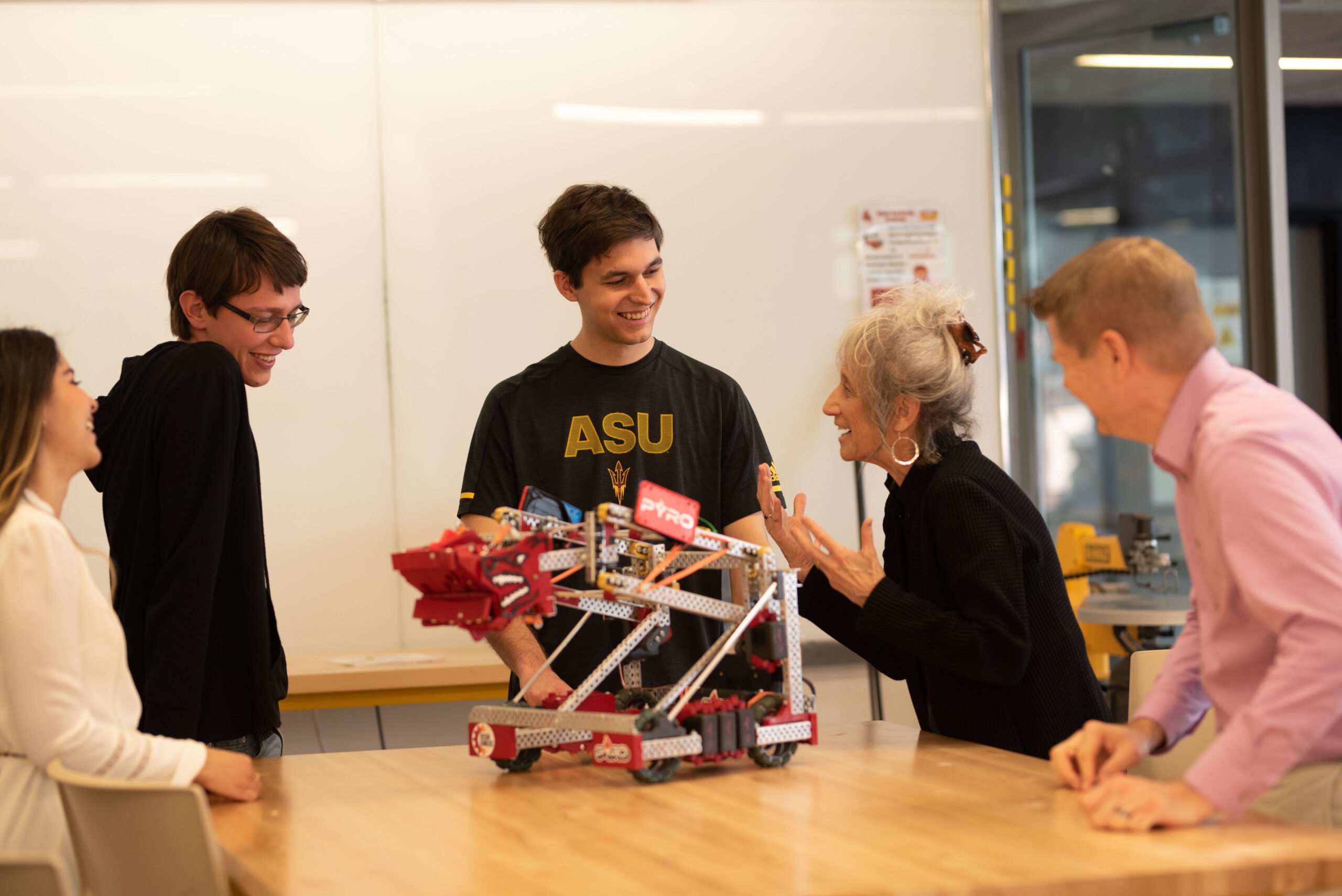
What if feedback could feel better?
What if instead of leaving feedback sessions feeling defensive, diminished, or confused, you walked away feeling:
- Clearer about what you’re trying to make and why
- Energized to return to your work with fresh perspective
- Connected to the people who witnessed and supported your process
- Confident that you can handle complex conversations about your work-in-progress
Liz Lerman’s Critical Response Process® (CRP) makes this possible.
What is the Critical Response Process®?
Critical Response Process® (CRP) is a structured method for giving and receiving feedback on creative work, developed by choreographer, educator, and author Liz Lerman in the 1990s. In practice for over 30+ years, CRP has become a cornerstone practice for artists, educators, nonprofit leaders, designers, scientists, and anyone who needs to have meaningful conversations about work that’s still evolving.
CRP fundamentally reimagines how we engage with each other’s work by centering:
Agency
Consent
Curiosity
Relationship
For the first time ever, we are launching an independent study course to learn and practice CRP.
Liz Lerman’s Critical Response Process® Essentials:
8 Self-Paced Units That Build Your Feedback Skills Step by Step
Unit 1: Orientation & Introduction to Feedback
- Set expectations for course structure
- Identify the origins and inventor of the Critical Response Process® (CRP)
- Uncover where feedback exists in everyday life
- Consider what values support functional feedback
Unit 2: CRP Roles & Steps Overview
Learn the four steps and three roles of CRP’s formal process Unit 2 Objectives:
- Consider personal preferences in feedback
- Identify some of the features that hold CRP together as whole
- Name the four steps and three roles of CRP’s form
- Reflect on the filters inherent in each step of CRP
Unit 3: Step One - Statements of Meaning
Practice noticing and naming what resonates before jumping to critique Unit 3 Objectives:
- Understand ways that the maker(s) can share the work before Step 1 begins
- Identify the main principles and spirit of Step 1
- Learn from different practitioners about how Step 1 is used in their fields
- Recognize the ways that Step 1 supports relationship building
Unit 4: Step Two - Maker's Questions
Understand how the maker directs the feedback they need Unit 4 Objectives:
- Identify the main principles and spirit of Step 2
- Learn from different practitioners about how Step 2 is used in their fields
- Understand role of the responders in Step 2
- Discover multiple pathways into question-forming
Unit 5: Step Three - Responder's Questions
- Identify the main principles and spirit of Step 3
- Learn from different practitioners about how Step 3 is used in their fields
- Name the possible challenges and current evolutions around the concept “neutral” in Step 3
- Practice turning opinions into questions that do not reflect those opinions
Unit 6: Step Four - Permissioned Opinions
- Identify the main principles, spirit, and script for offering opinions in Step 4
- Learn from different practitioners about how Step 4 is used in their fields
- Consider the role of consent, mutuality, and receptivity in giving and getting opinions
- Reflect on the progress of an opinion as it moves through the opportunities offered by the four steps of CRP
- Examine the possibility of saying no to an opinion
- Observe how the process can move backward in the steps and how the facilitator can guide the process to a conclusion.
Unit 7: Variations & Applications
- Learn about some of the ways that CRP is being used in diverse applications
- Identify the strengths of the traditional, four step CRP Process and how it is being evolved
- Discover some of CRP’s Variations: CRP with Yourself; Mutual Coaching; Reverse CRP
- Practice how disaggregating CRP’s steps independent from each other prove to be powerful tools
Unit 8: Review, Values & Integration
- Engage in a lightning round of CRP by joining in as a responder
- Review CRP’s key values such as: work in progress, agency, relationship building, engagement/suspension of judgment, and consent
- Learn from various practitioners about CRP’s valuable set of practices for giving and receiving feedback
- Identify various pathways to deepen engagement with CRP and introduce practices into your daily life
- Learn about other CRP programs and pathways to join the CRP community in continuous learning
The intentional service to the artist or maker was revealed and illuminated very clearly. The specificity of the steps and the careful filtering of the way responders shared information went deeper than I imagined. I found it fascinating to experience how and what each maker learned along the way. There was often a great sense of surprise and always a sense of gratitude. Rarely aspects of feedback I have been a part of in the past!
Thinking about how we ask questions isn’t new to me – I’m a lifelong practitioner of interrogation, arguments, and epistemology–I’m a teacher–but how to formulate neutral questions from the impulses of opinions was enlightening. I started to use it immediately in my conversations at home and with students and collaborators.
Invest in Your Feedback Skills
Join the pilot round of Liz Lerman’s Critical Response Process® Essentials
Who This Course Is For
Artists and creative professionals
Educators and facilitators
Nonprofit leaders and managers
Designers and makers
Scientists and researchers
hoping to offer clear and precise feedback in their teams
Anyone
who craves more productive feedback conversations
You don’t need any prior experience with CRP. This course is designed as an accessible introduction to the process.
Course Format
Self-Paced Independent Study
Liz Lerman’s Critical Response Process® Essentials contains 8 modulated video units with accompanying video transcripts and worksheets, led by Liz Lerman, Phil Stoesz, and Sumana Mandala. All designed to easily complete within 4-8 weeks.
What’s Inside:
- Watch real CRP sessions, including a delightful demonstration with a carrot cake
- Hear from practitioners using CRP in theater, education, organizational development, visual arts, sciences, and more
- Practice with activities you can do alone or with a partner
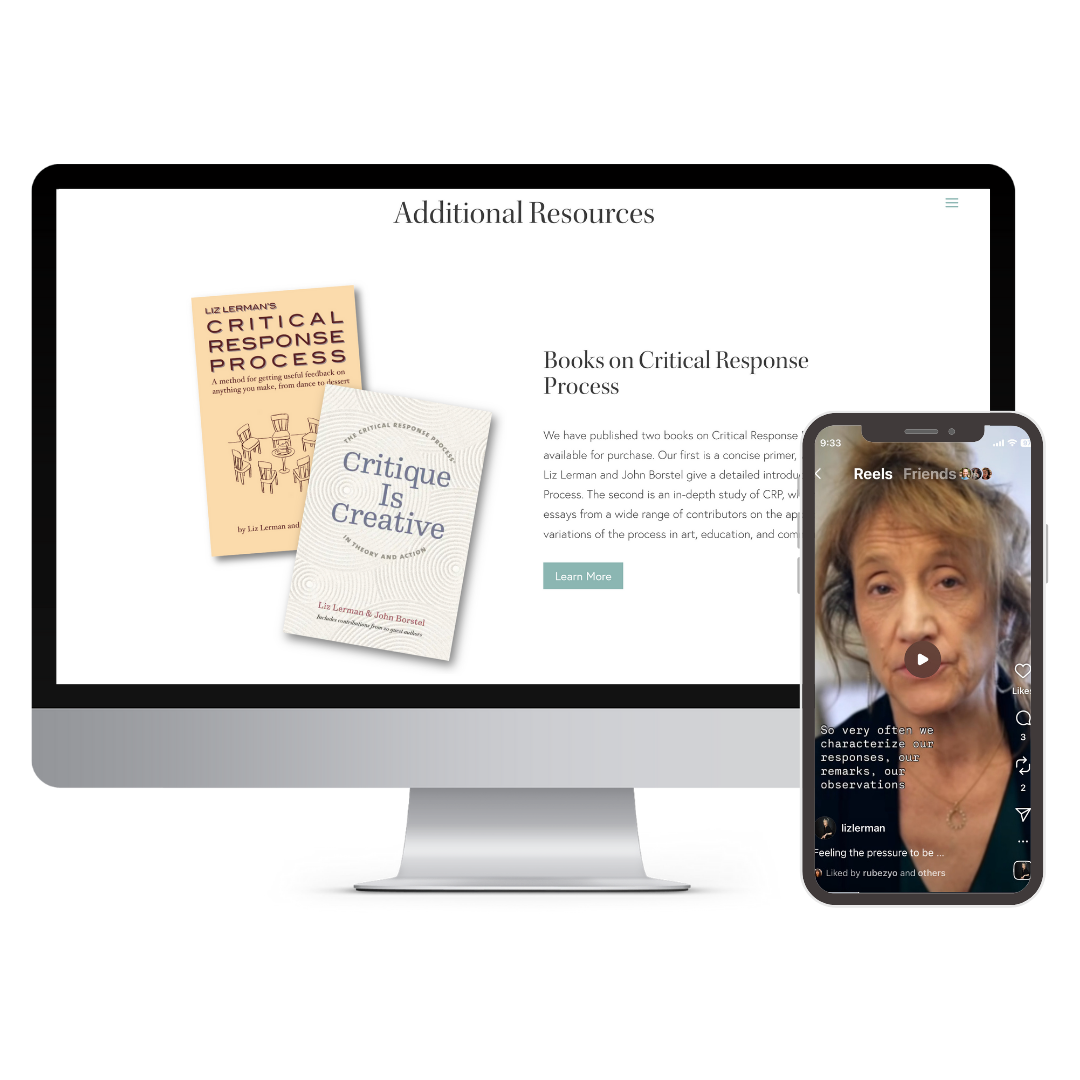
- Access readings from the book, Critique Is Creative (2022), which focuses on CRP in practice
Your Investment
Pilot Program
First-ever access to the full course (March 2026)- 8-Unit Course
- 1-Year Access
- Automatic Access to Upgraded Portal in 2026
- Early Access to Other CRP Programs
Official Launch
Wait for our comprehensive member dashboard (Fall 2026)- 8-Unit Course
- 1-Year Access
- Upgraded Portal Experience
- Early Access to Other CRP Programs
The pilot program for Liz Lerman’s Critical Response Process® Essentials will be released in March 2026.
Once purchased, this material is licensed to you for individual use only. You may not record, screenshot, reproduce, or share this content with others. By purchasing, you acknowledge this is copyrighted material and agree to these terms.
Not ready to enroll, but want to learn more?
Frequently Asked Questions
How long does it take to complete the course?
Do I need to practice with others?
While some deeper engagement activities encourage partner practice, you can complete the core course independently. Community is a key element of CRP, so we incorporate occasional practice with others.
I've taken a CRP workshop before/I've read the book. Is this course still valuable?
Is this only for artists?
Not at all! While CRP originated in the arts, the framework has been used successfully in education, organizational development, entrepreneurship, community work, research labs, and any context where feedback matters.
What if I don't like the course?
Due to the steep price discount and the nature of the planned delivery of our pilot program, we cannot offer any refunds for the pilot experience. Please purchase responsibly! This being said, we welcome your feedback! We have incorporated a segment for you to provide feedback called “CRP on the Course” at the end of Unit 8.
Learn directly from Liz & team
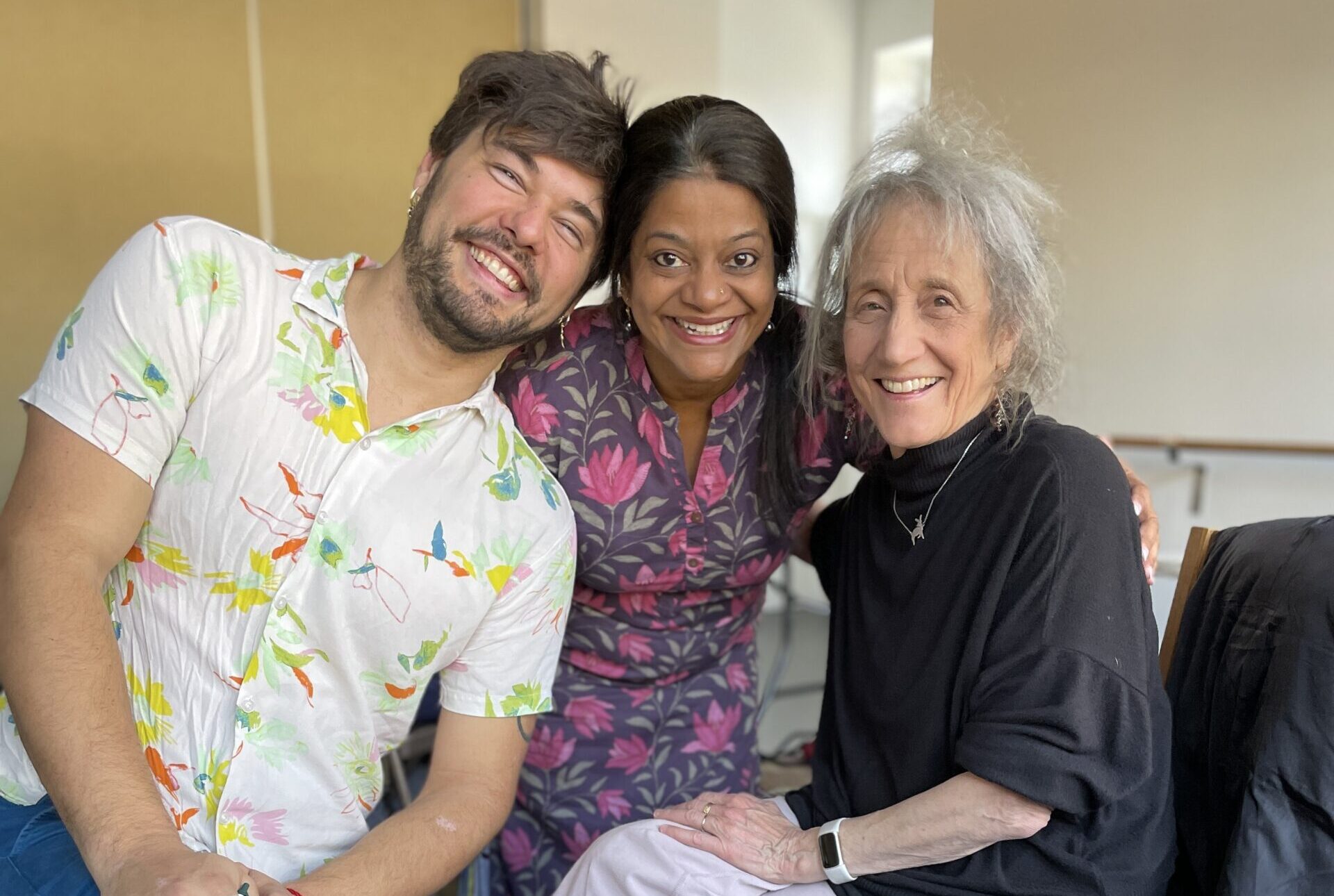
This course is taught by Liz Lerman, the inventor of the Critical Response Process® and an award-winning choreographer, performer, writer, teacher, and speaker. She has spent the past four decades making her artistic research personal, funny, intellectually vivid, and up to the minute. A key aspect of her artistry is opening her process to everyone from shipbuilders to physicists, construction workers to ballerinas, resulting in both research and experiences that are participatory, relevant, urgent, and usable by others. CRP is an essential way her work and thinking has influenced many groups beyond the dance community.
You’ll also learn from experienced CRP practitioners Phil Stoesz and Sumana Mandala, who bring years of experience facilitating and teaching CRP across diverse contexts—from dance companies to boardrooms, classrooms to community organizing. They currently are the Co-Directors of our CRP Certification program and CRP Fundamentals program.
Join a community of learners bringing better feedback practices into the world
photo credits: Adam Fontana, Amelia Cox, Ri Lindegren, Courtney Lively and Arizona State University
