
Liz Lerman’s blog
And, yes, she also blogs, albeit intermittently.
Insomniac Alerts
Questioning orthodoxy
My Rabbi Danny Zemel often says “if it is not broken, break it.”
There are two things people have said about me that I actually like:
1. Question everything. Liz Lerman does.
2. Liz Lerman can talk a hound dog off a truck load of meat bones.
Both of these ideas required me to behave outside the boundaries of the dance training I received in my earliest and most formative years. The beauty and disgrace of orthodoxy is that it isn’t questioned. You learn your place and you stay in line. You just do it as best as you can, or better yet, better than anyone else in line. When I first started to wonder about another way to do things, I literally shook with fear. When I first opened my mouth to speak in a dance class, I cried first. (To be perfectly honest, it was a theater class and we were required to speak. I cried anyway.)
My colleague and college friend, Wendy Perron, told me recently that she remembers me complaining constantly, and more than anyone else. It took me a long time to learn how to turn my complaints into questions. It narrows down to asking “why?” “Why is it done like this? Why is that better? Why am I supposed to do this? Why …?”
Once I started asking why, it was a lot easier to move from New York to Washington, to drop out of college, to go back and finish, to get old people to dance, to start talking on stage, to get people to say their names before an advanced technique class, to insist that dancers in the company – not me – teach the master classes, to do dances with political or spiritual content, to share in making something, to speak in public about art, to do a founder’s transition without leaving the company I had founded.
Although I’ve made a point of questioning orthodoxy, there’s plenty that I believe in. Here are a few ideas:
* Try to give dancers something to do, as opposed to something not to do.
* Try to create an environment of respect for all the collaborators, including the dancers.
* Sometimes the choreographer leads the dancers, sometimes the dancers lead the choreographer. Pay attention.
* There is a finite amount of emotional space in a theater. If the performers take up too much of it, there is not enough left for the audience. Choreograph accordingly. Check in with the performers to make sure they understand. Sometimes they need extra rehearsal for the emotional part so that they can discover how to let it go later.
* Performers need the most time to experience something. Choreographers need a little less. The audience needs a lot less. So edit.
* The problem isn’t being literal. The problem is being redundant. It is okay to be communicative and even expressive. Maybe we want to watch being illustrative or overstating. Be wary. The program notes, text, music, movement can all say the same thing (a problem) or all say something unique leading in a similar direction. Just to confuse matters, sometimes it is good to be redundant to make a point or to bring an audience to its experience of literacy for the night.
* Keep track of everything that is generated. It might come in handy.
* It is okay to talk about stuff outside of rehearsal. It won’t jinx the project.
* Sometimes the dancers know what is best to do next. They know it first. But sometimes they are wrong.
* I like to think of structure as a constant companion. It is always on my mind way before we go into rehearsal. Generally, it is still there by the time we are in tech rehearsals. Structure might reside in the content. Structure might need to be imposed. Structure is the choreographer’s business, domain, and personal playground.
* I like to discover new processes for each dance. I can fall back on old faithfuls — things I know will work. But I love it when I find something new to try.
* When people complain that something is “touchy-feely,” I always want to say: “ Well, yes, of course it is about touching and feeling.” I think when they say that, they are actually worried about rigor or the lack of it. If that is the case, be sure to be rigorous and be sure they know it is.
Nature and nurture
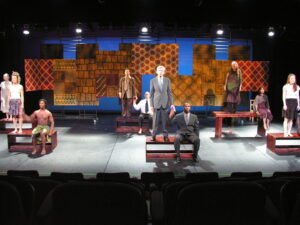
In 2007, Liz and members of the Dance Exchange were invited to Japan to facilitate workshops with the Kyoto Art Center, Japan Contemporary Dance Network, Fukuoka City Foundation for Arts and Cultural Promotion, and Yamaguchi Center for Arts and Media. Liz wrote this note attempting to make connections between her pieces “613 Radical Acts of Prayer” and “Small Dances about Big Ideas”. It still holds relevance today.
How to be an upstander rather than a bystander? The very cogent and difficult question posed by Samantha Power in 2002 book “The Problem from Hell: America in the Age of Genocide” through the powerful and brave human beings she chooses to chronicle in the midst of the pain of also describing years of genocide and mass mayhem. What makes it possible for some of us to do more than register our distress, shrug our shoulders, turn away, go shopping (or be told to go shopping by our leaders).
One of the scientists we came to know during our work on genetics is Bonnie Bassler, the American molecular biologist at Princeton. Bonnie has been working in the world of bacteria. What she posed initially is what makes one tiny bacterium realize that it can’t do its work alone. What makes the one tiny organism literally change its genetic makeup so that it can work as part of a group? And when it does that, Bonnie calls it quorum sensing, then the power of bacteria begins and we experience the impact of a viral epidemic.
Acting in the world alone or in groups can have such goodness and do such harm. What makes the difference? (Religion is supposed to help us make better decisions, but as we know too much faith can be part of the problem)… And is part of our dread of action the knowledge that it can go so wrong? Certainly part of our fear of engaging with others is losing the delight we might take in our own individual lives (for those of us lucky to enough to live in a time and place and with resources that make this actually fun).
Again, old questions for me and the Dance Exchange. We have covered this territory before. What makes this time new and special. I suppose again, I can explain it by thinking about science. The genome is showing us that without a doubt evolution has occurred. And at least in part, evolution is caused by the interaction of our genetic makeup with the environment. It is, it turns out, and we are all about both nature and nurture.
And so we might look and say that both our nature and our nurturing are being called into question right now. The actions of world governments require world citizens to wake up and look around. What does it mean to be an upstander and not a bystander? And how do we recognize the myriad ways people have tried and will imagine in the future, to bring their bodies and minds and spirits together to try to tame the viruses we inflict on each other?
Regarding governance. Or send in the Crones.
Regarding governance. Or send in the Crones.
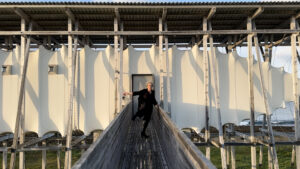
Once I accepted the commission from the Harvard Law School in 2005 to make a dance in honor of the 60th anniversary of the Nuremberg trials, I went to work researching. One of the first things I did was Google (it was relatively new then) poets and Nuremberg. What came up was something called the Norns.
It turns out that in Norse mythology, there were three old crones living under Mt. Nuremberg called the Norns. They had three jobs:
1. to keep the water clean,
2. decide who lived and died each day,
3. and to give legal advice to the Gods.
What a concept. Let’s send in the crones. We could have a seat next to each of our so-called elected officials and help them make ethical, legal, and humane decisions instead of the cruelty and submission we see right now.
You don’t have to be 77 years old, as I am, to watch in horror the deceit, power grab, and disintegration of our ideals. But perhaps we need all the old people in the U.S. to organize and get on the streets. We don’t have that much to lose.
Living in chaos
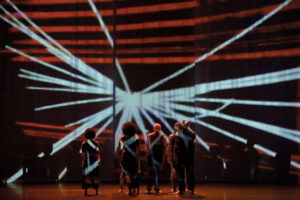
Let’s consider the Big Bang as a fable. In an instant, not even an instant, we are all born. All of it. Yet it is nothing. It’s a swirling, entirely unpredictable, intense amount of energy forming and falling apart and forming again. In fact, there is no shape. Nothing sticks together. After all, nothing is nothing.
But then, a very long time later, somehow there is stuff. Tiny bits of stuff that emerge because gravity has discovered itself and can exert enough pressure for a thing to be seen. But still nothing sticks together. It takes thousands of what we would now call years for any of this stuff to stay in relation. It does come together, but it falls away quickly.
Amazingly, stuff learns to form some kind of bond, and the parts decide to stay in relationship. Together, in a new shape, they become something like a molecule, and then more of them join the same shape or form new ones. And so, something new begins to happen. There is more than one way to be a connected shape; more ways to be in relation.
What makes the stuff stick together long enough to form a relationship? Initially, what holds is the vibration, the sensing, the sound making, the motion, the communicating; all the things we now call creativity. That’s what it is. It is the elements of creativity that hold us through the joys, miseries, troubles, mysteries, and challenges that come with relationships.
It would be thousands of years before we name some of the ways that creativity works through repetition and innovation. We might call those elements artists. Artists whose lives are made up of coming together in relation, making all kinds of things, and then falling away into a new pattern. People who make the vibration, the sensing, the sound, the motion, the communicating their life’s work.
In 2025, as I write this, we are living in chaos again. Let us understand that our work is to bring people, animals, environment, into relation and try to sustain that long enough to learn how to see the inevitable joy, misery, trouble, mystery, and challenges that come with so many ideas, ideals, and institutions falling apart. We are called back to the essence of who we are and what we know and how to continue as gravity rearranges itself. We construct new molecules and learn to careen in fresh ways as we live with ourselves, our communities, and our big dreams. The world we are making requires our two constants: creativity and relationship.
Contribution for Alexandra Beller’s upcoming book “Anatomy of Art” – Chapter on Relationship
This is a time for speaking
There are many beautiful traditions within Judaism that have been passed down to me. The Judaism I have inherited comes with deep inquiry, a sense of awe, and a demand that it is a civilization to be grappled with. Often, this takes the form of Midrash, a type of discussion that transverses centuries, as people confront text that is ancient and make it mean something in the present. What follows is from the book of Ecclesiastes 3, verses 1-8, which is a famous text that many of you will recognize as variations in a song Turn Turn Turn that Peter Seeger, the Limelight’s and the Byrds made famous in the 50’s and 60’s.
“Everything has an appointed season, and there is time for every matter under heaven
A time to give birth and a time to die; a time to plant and a time to uproot”
There is never a time for starvation. Never.
The biblical verse continues: “There is a time to cast stones and a time to gather stones”
So let me cast a stone: What is happening in Gaza is an abomination. I love being Jewish, but I do not support what the Israeli government is doing to the people of Gaza. Saying it does not make me antisemitic. Just like being against the actions of my own government doesn’t make me anti-American.
The verses continue …
“There is a time to be silent and a time to speak.”
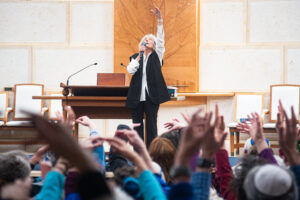
This is a time for speaking.
And one thing we can say together is there is never a time for one nation to starve the people of another. Never.
A conversation with the Covenant Foundation
What is on your mind these days?
I’m thinking deeply about equity and justice and what my role is in bending the world in that direction. In all of my conversations, I bring forward my Jewish spiritual life. I try to speak from experience, not authority; then beautiful things can happen.
I believe that in Judaism we form new relationships with the past, if we are lucky. So much of what we are fighting over in the streets is our histories and how they impact the present; the retelling of our Jewish stories along with fresh commentary is a way of dealing with the implications of the past.
Can dance be a healing process?
Absolutely. Engaging our full selves includes our bodies. Just moving and being part of a group in song, or just bringing our arms up together is beautiful. People feel so much more connected. I’ve put my whole life into this, and it surprises me that it’s still unusual.
People are more fully themselves when engaging in healing or in being in relationship with others. The questions are not just their own. Those acts help heal the inner soul too.
I understand that shechayanu is your favorite prayer.
I first started to bring shechayanu into multi-cultural and multi-religious settings — which are most of the settings I’m in — in the 1990s, talking about how identity and different cultural forms play out on stage. I would introduce myself with the shechayanu and first translated it as we learned it, thanking God for granting us life, sustaining us and giving us structure, and helping us reach this day. Then I would retranslate it for artists: Isn’t it amazing that given our histories, that we should be here at this moment, right now, together?
What kind of work are you doing with synagogues?
This year, I will work with Temple Micah in the afternoon of Yom Kippur. The place is usually packed then and everyone knows that’s the time when we’ll use our bodies. This year we’ll try it virtually, with everyone in their homes. Preparation begins in Elul, when Rabbi Daniel Zemel puts forth a question and people send their personal stories back. The rabbi also selects a few congregants to help me make the dance. It is really an eclectic group of all ages. We look through the stories and turn them into a dance that will be taught and then set to a prayer that the cantor selects. Again the dance and the moving holds multiple purposes, bringing us together, hearing the stories in a new way, and helping us get through the long day that is Yom Kippur.
How does this moment in America relate to your preparation for the High Holidays?
I want to talk about Ibram Kendi’s book, “How to Be an Antiracist.” I heard him say that you’re either in denial or confession, as white people. I found this useful. When I am in conversation with friends and these issues come up, rather than going into denial, it’s better according to my understanding of Kendi to jump to the other side. Do I need to confess? What I have found powerful is that this forces an deeper reflection on what we mean by apology. A lifetime of Yom Kippur has given us rehearsal. When we spend weeks preparing and thinking about our year and our actions, about ourselves and our community. As Jews, we have this very compelling practice of atonement. You don’t get off easy. That’s what Kendi has come to mean for me. Confession, as I have come to understand it as a Jewish concept, is bigger and deeper and more demanding than mere apology .
Where is God in all of this?
I think God is an example of our extreme creativity. Trying to make space for people to recall their innate creative selves is Godlike for me. I am amazed and startled by people’s capacity to do this. My rabbi once said that God is most Godlike when creating. We are created in God’s image and we are most Godlike when we are creating. That is a sustaining thought.

Today I am 67 years old.
This post was written on my birthday, December 25th, 2014 while I was visiting my daughter in Cambodia. Today I am 67 years old. Here is an account of some of what I have accumulated.
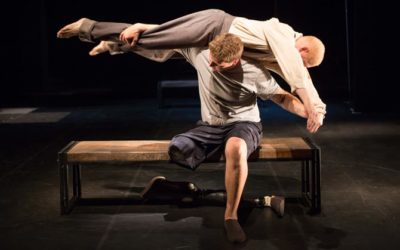
Risk. Purpose. Love.
Yesterday was Veteran’s Day. I think we need these reminder days that give us all a chance to think together about something or someone that matters to us.
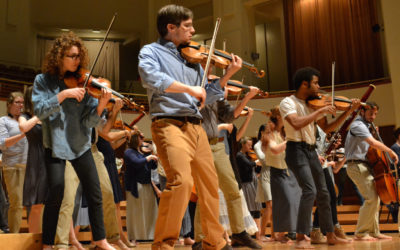
Dances for Martha: A remake of Appalachian Spring
Last month Jim Ross and I premiered our latest project. The orchestra memorized “Appalachian Spring,” and then they danced it. Our team included Martha Wittman, Vincent Thomas, and the conductor Enrico Lopez-Yanez. It was magical.
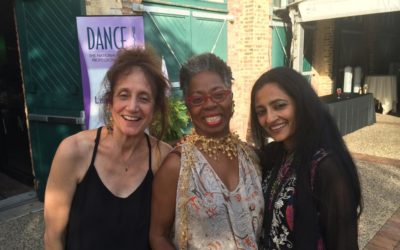
What I didn’t say at Dance/USA
It was such a surprising moment to be honored at Dance/USA a few weeks ago. Jawole Zollar’s introduction was in itself an honor, and it was a great pleasure to see so many colleagues all in one place. After giving my “speech” I sat down and then immediately realized what I had forgotten to say.
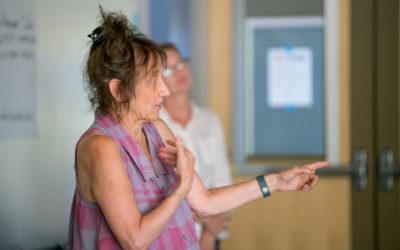
Toolbox as Documentation
I am interested in how we observe our processes, discern them as repeatable actions, develop them to become tools for others to borrow and make their own. I believe that we can harvest our histories, make sense of what we did and describe it in terms that help us understand the context, the decisions, and perhaps the wisdom and meaning surrounding the work.
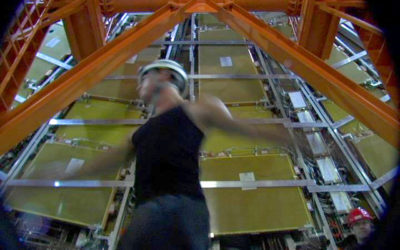
Artists Without Edges
Artists know that if categorized in one way, it will be hard to get observers, presenters, critics and curators to see them in any other light. And so the denial begins. It is sad to watch, and sad to be in that circumstance.
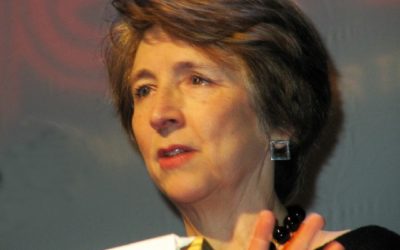
The Amazing Rebecca Blunk
Today we got news that the amazing Rebecca Blunk will be stepping down as head of the New England Foundation for the Arts due to health and personal reasons. I entreat everyone to take a moment and just close your eyes and thank Rebecca in whatever form you express gratitude.
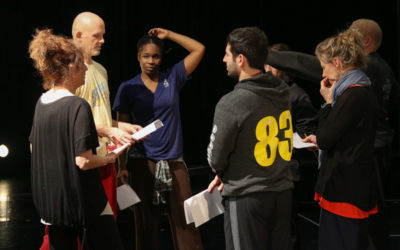
Harvesting Intuition
I have been trying to harvest my own intuition. I think of intuition as our knowledge…just really, really fast. Before you can do this, you have to realize you are having an experience. This might be something as conscious as moving improvisationally, problem solving in rehearsal, or veering of the plan while teaching.
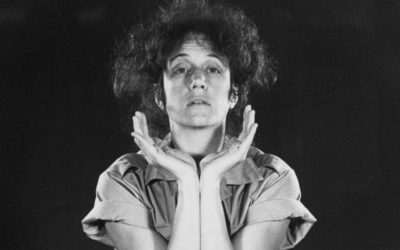
An Older Body Getting Older Remembers
As I advance through my sixties, people are curious about my experience now that I am reaching the age of many of the older dancers with whom I’ve worked over the course of my career. I am curious too.
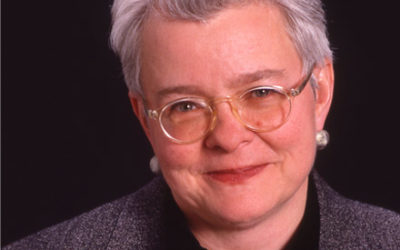
A conversation with Paula Vogel
One of the perks of working on a Civil War Christmas at CenterStage in Baltimore was getting to share a brief cup of tea with the playwright Paula Vogel.
Sign Up
It is our intention to be generous in sharing our world with you. You can expect to hear about works in progress, Liz’s thoughts on teaching and creating new courses, news of awards and achievements, and more regular writing from Liz about dance, responding to art, and more. We welcome your reflections and support.
We will never ever ever sell or share your name.